Current Events Crossword Puzzles: A Weekly Classroom Ritual
How to build a current events crossword every week: news-grounded AI puzzles, topic generation, and a free word list maker for this week's headlines.
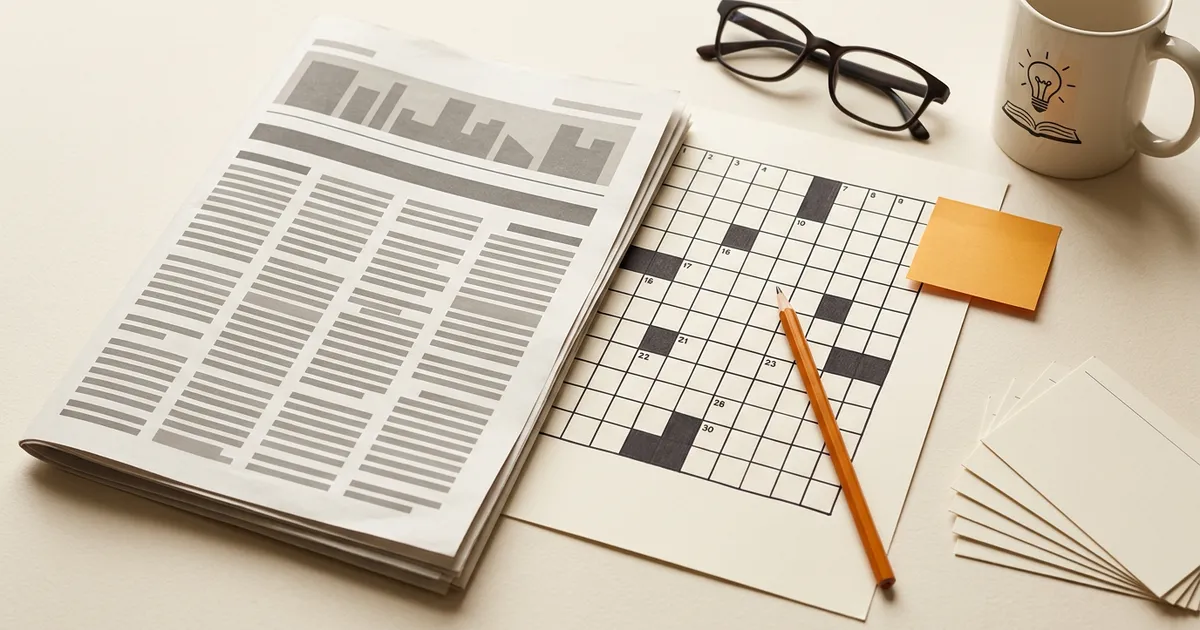
A current events crossword is a crossword whose answers come from recent news: the people, places, institutions, numbers, and vocabulary that appeared in the week's coverage. In classrooms it does a job that a news quiz cannot, because the crossing letters keep a student working on a term they half remember instead of leaving it blank and moving on.
This guide covers what makes a good current events puzzle, three ways to build one (including which parts are free), and a Monday to Friday routine you can run every week without it turning into a second prep period.
Why teachers use current events crosswords
The format survives in classrooms because it stacks several things a weekly news activity needs.
Retrieval practice, not recognition. A multiple choice news quiz lets a student pick the answer that looks familiar. A crossword makes them produce the term from memory. That production step is what moves vocabulary from "I have seen this word" to "I can use this word."
Media literacy by repetition. Words like SANCTION, INFLATION, VETO, EMBARGO, RECALL, and INDICTMENT show up in headlines constantly and are misunderstood constantly. Putting them in a grid, with a clue written as a plain definition, quietly builds the vocabulary students need to read the news on their own.
Self-scaffolding difficulty. Crossings mean a hard answer becomes reachable once the easy ones around it are in. You get a single activity that a mixed-ability class can all finish, which is why it works so well as differentiated vocabulary practice.
Low stakes, high engagement. Students who freeze on a quiz will happily argue with a partner about a crossword. The puzzle framing removes the assessment pressure while keeping the recall work intact.
It stays fresh by definition. A vocabulary unit repeats every year. The news does not, so the same activity never goes stale, and students notice that the puzzle is about the world they are actually living in this week.
Three ways to build a current events crossword
There are three practical paths in Grid Genius, and they differ in cost and in how current the content can be. Be clear on which one you need before you start.
1. News-grounded generation (Pro)
This is the closest thing to a one-step current events puzzle. In the app, open Create, enter your topic, expand Advanced options, and under Search Sources turn on Web Search ("Search the web for current news and trends"). The generator searches the web for current information about your topic before it writes the word list and the clues, so the answers reflect recent coverage rather than only what the model already knew.
Two extras sit alongside it:
- Search guidance is a short optional field where you steer the search. Something like "Focus on this month's state legislature votes" or "Recent breakthroughs and company announcements" narrows what the puzzle draws from.
- X/Twitter Search is a second source toggle, with an optional handle if you want the search pointed at one account.
Both toggles are Pro features. On a free account they are shown with a PRO badge and the server declines a grounded request, so this is the honest dividing line: news-grounded puzzle generation requires a Pro subscription.
One caveat that applies to any AI-written news puzzle: solve it yourself before class. Fast-moving stories change midweek, and a clue that was right on Tuesday can be stale by Friday. Treat the generated puzzle as a strong first draft, not a proofed worksheet.
2. Topic generation (free allowance, then Pro)
Plain AI generation without the search toggles is available on free accounts. Every account gets a starter allowance of three AI generations, and once those are spent, accounts earn one more free generation per day from the day after signup. Pro removes the limit.
The important distinction: topic generation is not news-grounded. It draws on what the model knows about the subject rather than searching this week's coverage. That makes it excellent for the background concepts a news unit needs (ELECTORAL COLLEGE, SUPPLY CHAIN, CENTRAL BANK, HABEAS CORPUS) and the wrong tool for "what happened on Tuesday."
A useful pattern is to run both: a background concepts puzzle at the start of a unit, then a genuinely current puzzle at the end of the week.
Browse puzzle topics3. The free Word List Builder (no account)
If you want the puzzle to be exactly this week's news with no verification risk, type the terms yourself. The Word List Builder is free, needs no account, and takes your words and clues as written. You paste in the ten terms your class read about, write clues in your own voice, pick a grid size, and get a puzzle plus an answer key you can download or share as a playable link.
This is the path most teachers end up running weekly, because the term collection is the part that carries the pedagogy anyway. It also scales down neatly: five terms in a 7×7 mini grid is a five-minute bell ringer.
The Monday to Friday routine
The reason current events crosswords fail as a classroom habit is usually not the puzzle, it is the prep. Spreading the work across the week fixes that.
Monday: news intake. Students read or watch the assigned coverage and log terms in a shared doc or on an index card. Ask for a fixed number, usually three to five each, with a one-line note on why the term mattered. The collection work is now theirs, not yours.
Tuesday and Wednesday: keep collecting. Add terms as new stories break. Do not curate yet.
Thursday: cut the list. Ten to fifteen answers for a full class period. Prefer single words without spaces or hyphens, since those grid cleanly. Mix three or four easy confidence builders in with the harder terms so the crossings do their job. Drop anything you cannot verify in a source, and drop anything whose "correct" answer is really an opinion.
Thursday: build and solve it yourself. Whichever of the three methods you used, do a full solve before it reaches students. You are checking two things: that every fact is right, and that no clue has a second defensible answer.
Friday: solve, then discuss. Ten to fifteen minutes on the puzzle, then the real payoff, which is the conversation. Ask which term students had never heard before Monday, which story they would follow next week, and which clue they thought was unfair.
Three variations worth keeping in your pocket:
- Paper only. Print the numbered grid with its Across and Down lists and hold the answer key. See the guide to printable classroom crosswords for the layout details.
- Anti-copy sets. On a paid plan you can generate up to four versions of the same puzzle, labeled A to D, with identical answers on different layouts, so desk neighbours cannot copy. More on that in crossword versions that prevent copying.
- Student built. Once a month, let a group build the puzzle for the rest of the class in the Word List Builder. Writing a clue is a harder comprehension task than solving one.
Where current events crosswords come from
| Source | How current | Prep effort | Cost | Curriculum fit | Digital play |
|---|---|---|---|---|---|
| News-grounded AI generation | This week's coverage | Enter a topic, then verify | Pro | Good, steerable with search guidance | Yes, shareable link |
| Topic AI generation | Background concepts, not headlines | Enter a topic, then verify | Free allowance, then Pro | Good for unit vocabulary | Yes, shareable link |
| Free Word List Builder | Exactly as current as your list | You supply words and clues | Free, no account | Exact, it is your list | Yes, shareable link |
| Newspaper puzzle archives | Dated to publication | Find and print | Often subscription | General audience, not your unit | Varies |
| Generic worksheet sites | Whenever it was uploaded | Search and hope | Usually free | Rarely matches your coverage | Usually print only |
| Building the grid by hand | Fully current | Hours | Free | Exact | No |
The honest read: if you want a puzzle about this week specifically and you want it for free, the Word List Builder is the answer, because you supply the currency. News-grounded generation buys you the collection and clue writing work, and that is what the Pro subscription is for.
Writing clues for news that hold up
News clues fail in ways that vocabulary clues do not. A few rules keep them solid.
Clue the term, not the take. "Trade tax on imports" is a clue. "Policy that hurt farmers" is an argument. Ask for FILIBUSTER, TARIFF, QUORUM, RECALL, or CENSUS and let the discussion carry the interpretation.
Watch the decay date. Anything phrased as "current" or "latest" ages badly. If you reuse a puzzle next term, "the country that hosted the 2026 summit" still works, while "the newly appointed minister" does not.
Handle sensitive stories carefully. Skip clues that turn a victim's name or a tragedy into a puzzle answer. Cover the story in discussion instead, and keep the grid on the vocabulary and civics around it.
Mind the letters. Multi-word names and hyphenated terms need to be entered without spaces, which gets awkward past about twelve characters. Prefer single words, and save the long proper noun for the discussion.
Vary the ask. Mix straight definitions with geography ("Country where the flooding hit"), institutions ("Body that sets interest rates"), and one number written as a word. The variety keeps strong solvers honest.
If a student stalls on a clue during the solve, the AI Hints in the app rephrase the clue or offer a related fact instead of revealing letters, which keeps the recall work with the student. Free accounts get a daily hint allowance, and Pro removes the cap.
Not a teacher? Two other uses
News junkies. A weekly puzzle from your own reading list is a surprisingly sharp self-test on what you actually retained versus what you scrolled past. Turn on Web Search on a topic you follow closely and see how many answers you already know.
Newsletters, clubs, and staff meetings. A five-word mini crossword from the week's internal news works as an opener that people finish, unlike a trivia round that stalls. The share link opens on any phone with no signup.
For a broader look at building classroom puzzles of any kind, the crossword puzzle maker for teachers guide covers grid sizes, clue difficulty, and sharing. And if you are starting the routine in September, the back to school crossword post has icebreaker word lists to launch with.
Frequently asked questions
A current events crossword is a crossword whose answers come from recent news: the people, places, institutions, and terms that appeared in this week's coverage. Teachers use it as a weekly retrieval-practice activity, usually built from the same articles or newscasts the class worked through during the week.
Yes. The Word List Builder is free with no account required: you enter this week's terms and clues, and it arranges them into a grid you can print or share as a playable link. Free accounts also get a starter allowance of AI topic generations plus one more per day after that. News-grounded generation, where the app searches the web for current coverage before writing the puzzle, is a Pro feature.
Ten to fifteen words is the sweet spot for a class period. That fits a standard 11×11 grid comfortably and leaves room for discussion after the solve. For a five-minute bell ringer, use a mini 7×7 grid with five to eight terms from a single story.
Build clues around vocabulary and verifiable facts rather than positions. Ask for the term (FILIBUSTER, TARIFF, CENSUS), the place, the institution, or the number in the story, not for a judgment about it. The puzzle is the retrieval activity; the discussion afterward is where interpretation belongs.
No. A shared puzzle link opens in any browser on any device and solvers can start without signing in. If your students are on paper instead, you can print the grid with its numbered clue lists and a separate answer key page.
A real crossword on any topic.
AI-generated puzzles with smart hints that help you think, not just give away answers. Free to play, no sign-up required.