Differentiated Vocabulary Activities with One Crossword
Differentiate vocabulary review with one crossword: teacher-written backup hints scaffold struggling students while fast finishers stay challenged.
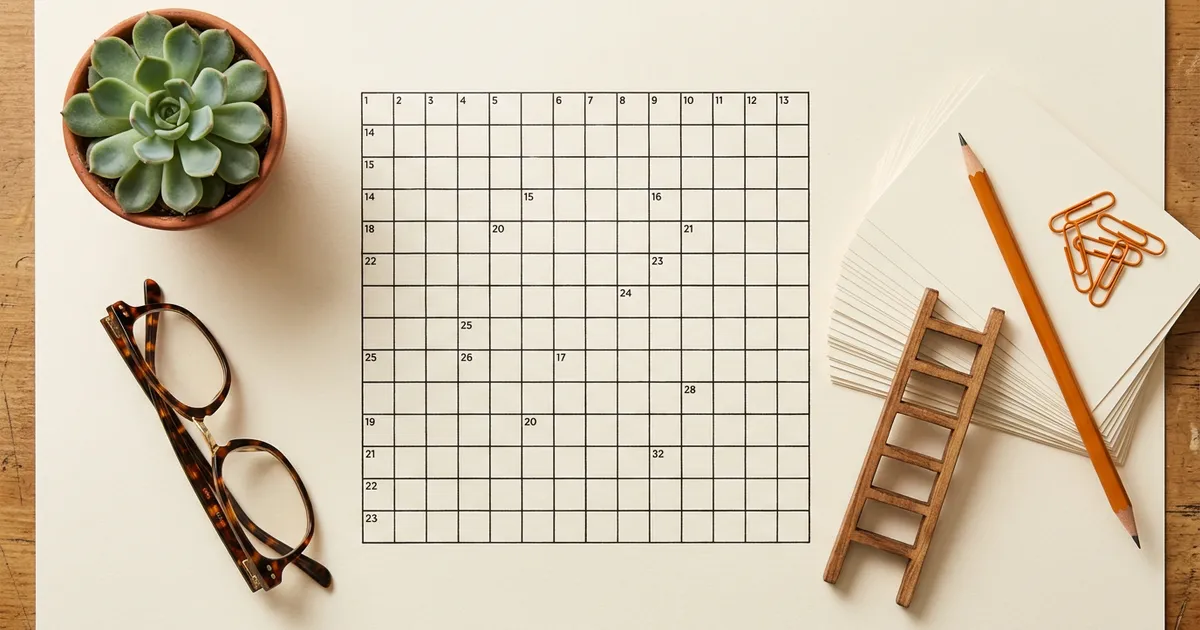
Differentiated instruction sounds great in a staff meeting and falls apart at the copier. Making three tiers of the same worksheet triples your prep, and handing them out tells every student exactly which group you think they belong to. So most vocabulary review quietly gets pitched at the middle of the class, which bores a third of the room and loses another third.
There is a simpler way to differentiate vocabulary review: give every student the same crossword and vary the support instead of the task. In the Grid Genius Word Builder, you can attach a backup hint (a second, plainer clue) to any word. A student who gets stuck taps "Reword this clue" and sees your hint first, clearly labeled as the maker's hint. A student who is cruising never opens it. One puzzle, one link, and the scaffolding appears only for the students who reach for it.
Why one puzzle beats three tiered worksheets
The traditional tiered-worksheet approach differentiates the task itself: the support tier gets easier words, a word bank, or fewer blanks, while the challenge tier gets extension questions. It works, but it has three costs that add up fast.
Prep multiplies. Every unit now needs two or three artifacts instead of one, plus separate answer keys, plus the logistics of handing the right sheet to the right student.
The target moves. If the support tier never faces the on-grade definition of "photosynthesis," they were never really assessed on it. Lowering the task lowers the ceiling for exactly the students who need the most practice reaching it.
The labels show. Students notice which worksheet they got. Research on classroom grouping keeps circling the same finding: visible ability labels change how students see themselves, and rarely for the better.
A crossword with layered hints flips the model. Everyone faces the same words and the same on-grade clues, so the learning target never moves. What varies is the support, and that support is opt-in, private, and per word. A student who needs help on two of fifteen words takes it on those two words only, without anyone else knowing, and still earns the same completed grid as the fastest solver in the room.
The hint ladder built into a crossword
Crosswords arrive with a scaffold already installed: crossing letters. A student who cannot recall "peninsula" from the clue alone may get its P and its N from words they do know, and suddenly recall has something to grab onto. That is rung one of the ladder, and it costs you nothing.
Backup hints add rung two. When you build a puzzle from your own word list, you can write an optional second clue for any word. A stuck student who asks for help sees your hint first, labeled MAKER'S HINT, before anything else. It is your voice, your phrasing, the same move you would make kneeling next to their desk: say the same idea a different way.
Rung three is AI Hints. On words where you did not write a backup hint (or when a student needs still more help), Grid Genius generates a fresh rephrasing of the clue or a related fact. The hints are progressive and deliberately do not hand over the answer, so even a student on their third hint is still doing the final step of recall themselves.
Here is the whole ladder in one small puzzle. Play the stuck student: the crossing words have already given you two letters, and the hint button climbs one rung at a time.
That last property is what makes the ladder pedagogically sound. Every rung returns the student to the act of retrieval. Compare that with the "reveal a letter" button in most puzzle apps, which trades away exactly the mental work you assigned the puzzle to create. If you want the mechanics of setting all this up, the backup hints guide walks through the builder step by step.
Writing a backup hint that actually scaffolds
The craft is in changing the angle, not just the wording. A backup hint that is a thesaurus-swap of the main clue leaves a struggling student exactly where they were. Three moves work reliably:
- Plain-language restatement. Strip the academic register and say it the way a student would.
- Context sentence with a blank. Put the word in a sentence from daily life and let the sentence do the teaching.
- Category plus a familiar example. Name the family the word belongs to and point at an instance the student already knows.
| Word | Main clue (on grade level) | Backup hint (the scaffold) |
|---|---|---|
| Photosynthesis | Process converting light energy into chemical energy in plants | How a plant makes its own food using sunlight |
| Metaphor | Direct comparison of unlike things without using like or as | "The classroom was a zoo" is one of these |
| Peninsula | Landform bordered by water on three sides | Florida and Italy are both this kind of landform |
| Denominator | The divisor in a fraction | In 3/4, the 4 is this |
A few things to avoid. Do not give away the first letter; crossing words already do that job. Do not restate the clue at the same difficulty; the student already failed that register once. And keep the answer itself out of the hint, including its root: a hint containing "synthesize" has already solved "photosynthesis."
Calibrate your eye on three quick calls. Each pair has one hint that scaffolds and one that breaks a rule you just read:
Running it with a real class
One link serves everyone. Word list puzzles are private by default: they never appear in public browse or search, and only people with your share link can play. Students do not need accounts or a paid plan, and your backup hints are served free to every solver, guests included. The puzzle runs in any browser at play.gridgenius.app and in the Grid Genius iOS app on iPhone and iPad.
Paper still works. Export any puzzle to a PDF with the numbered grid, clue lists, and an optional answer key page for class sets, following the same flow as our classroom printables guide. If desk neighbors tend to compare answers, print the class set as up to four versions of the same crossword: identical words and clues, different grid layouts, each with its own matching answer key. Backup hints stay digital, which is quietly useful: they become your personal list of ready-made verbal prompts for students who raise a hand over the paper version.
Give fast finishers the maker's seat. The strongest extension activity is not a harder puzzle, it is the other side of the desk: have early finishers build their own crossword on the unit and write backup hints for classmates. Constructing clues at two difficulty levels demands deeper processing than solving ever does. Our crossword maker guide for teachers covers the workflow, and the research summary in crossword puzzles for students explains why the retrieval practice pays off. For multilingual classrooms, the same two-clue structure doubles as language support; see our ESL crossword guide for that angle.
Short on prep time? AI Generation can build the puzzle for you: type a topic like "cell biology" or "the French Revolution" and Grid Genius generates a complete crossword with words, clues, and grid. AI Hints work on those puzzles too. When you need full control of the word list and the scaffolding, build from your own words; when you need a review activity for tomorrow morning, generate one.
Frequently asked questions
Build one crossword and vary the support instead of the task. Crossing letters help everyone, teacher-written backup hints give struggling students a second clue on demand, and AI Hints offer further rephrasings. Every student works the same words and the same on-grade clues.
A hint ladder is a sequence of progressively stronger supports a learner climbs one rung at a time: first crossing letters, then a teacher-written backup hint, then AI Hints that rephrase the clue. Each rung hands the work back to the student, so the final act of recall is always theirs.
No. Anyone with the share link can play, including guests who never sign in. Your backup hints are served free to every solver of your puzzle, and AI Hints are available with a daily free allowance.
Yes. Any subject with terminology works: science, history, geography, math vocabulary, world languages. Write the main clue the way you would ask it on the test, and use the backup hint for the plainer restatement or a context sentence.
Yes. Every puzzle exports to a PDF with the numbered grid, clue lists, and an optional answer key page. Backup hints do not travel onto paper, so keep them for yourself as a ready-made list of verbal prompts for students who raise a hand.
One list, one link, every learner
Differentiation does not have to mean more versions, more copies, and more visible sorting. Write one good word list, clue it at grade level, and put your scaffolds one tap away for the students who need them. The students who never tap never know; the students who do get you, at your best, saying it a different way.
Build your differentiated crossword freeA real crossword on any topic.
AI-generated puzzles with smart hints that help you think, not just give away answers. Free to play, no sign-up required.