Personalized Crossword Gift: Facts Become Clues
Make a personalized crossword gift the easy way: list a few plain facts about someone and AI turns each one into a clue and builds the grid. Free, no account.
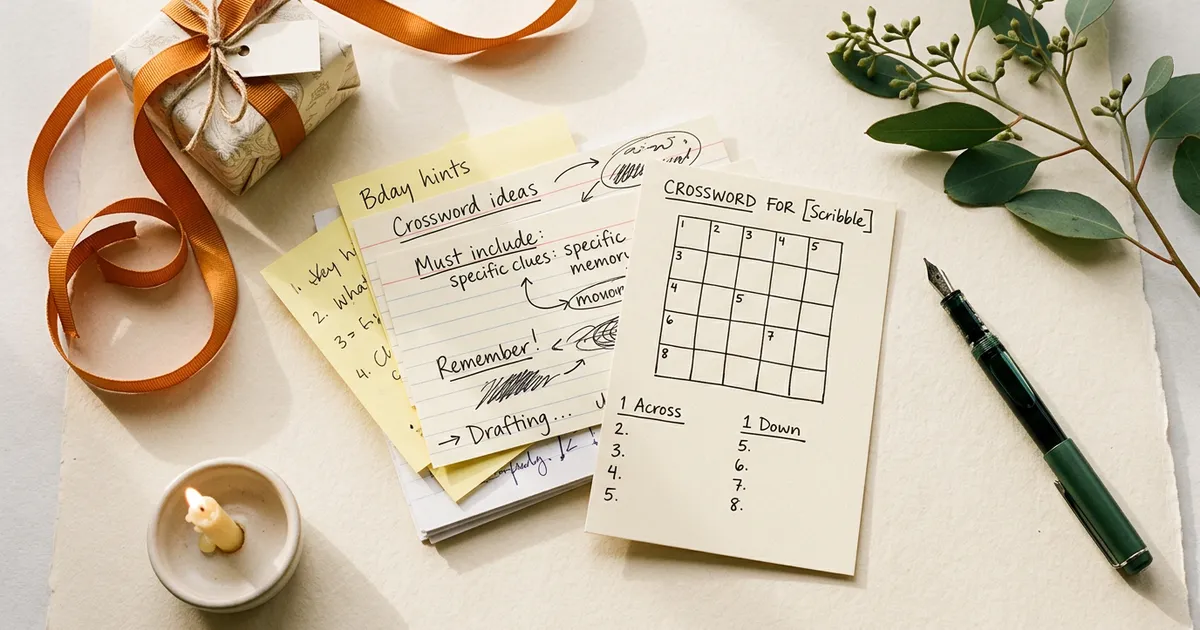
A personalized crossword gift is the rare present that is impossible to buy and, until recently, genuinely tedious to make. The idea is simple: a puzzle where the clues are about one person's actual life. The friction was always the middle step, turning "she grew up in Naples" and "her dog is named Biscuit" into properly worded clues, real answer words, and a grid where everything interlocks. The new personal mode on the Grid Genius maker removes that step entirely. You write the facts in plain language, and the AI does the crossword thinking for you.
This is different from the older way of making a personal puzzle, where you typed both the answer and a clue for every single word. Here you never write a clue at all unless you want to. Personal mode lives at gridgenius.app/create/personal, it is free, and it does not require an account.
Try it right here. Edit the facts and see the clues it writes.
How personal mode actually works
You do three small things. You say who the puzzle is for and what the occasion is. You list somewhere between 3 and 10 plain facts about them. Then you let the AI build it.
Each fact you write becomes one entry in the grid. The AI reads a sentence like "We met in Goa in 2019," decides the answer word is GOA, and writes a crossword clue for it, something like "Beach state where we first met (3)." It does this for every fact. Because a handful of personal words rarely interlock into a clean grid on their own, the AI also adds a few gentle theme words tied to the occasion, so a birthday puzzle might pick up CANDLES or EIGHTY to help the grid lock together. Then it constructs the layout: numbered squares, Across and Down clue lists, the whole thing.
This is the same AI puzzle generation that powers Grid Genius when you type a topic and get a full crossword back, pointed at the most specific topic there is: one person. You are not choosing from a library of generic clues. Every clue is written fresh from your fact.
A real example: Grandma's 80th
Say you are making a puzzle for a grandmother turning 80. You would not sit down and invent crossword answers. You would just jot what is true about her. Six facts might be:
- She was born in Naples in 1946.
- Her garden is full of tomatoes.
- She taught third grade for thirty years.
- Her late husband was named Arthur.
- Her lasagna is the reason everyone shows up on Sundays.
- She has seven grandchildren.
Personal mode reads those and produces entries roughly like this:
| Your fact | Answer | Clue the AI writes |
|---|---|---|
| Born in Naples in 1946 | NAPLES | "The Italian city where her story starts (6)" |
| Garden full of tomatoes | TOMATO | "What she grows more of than she can give away (6)" |
| Taught third grade | TEACHER | "Her job for thirty years, and still her instinct (7)" |
| Husband named Arthur | ARTHUR | "The name on the other pillow for forty years (6)" |
| Famous lasagna | LASAGNA | "The Sunday dish that fills the house (7)" |
| Seven grandchildren | SEVEN | "How many of us call her Grandma (5)" |
Then it adds a couple of occasion words like EIGHTY and CANDLES so those six personal answers interlock into a proper grid, and lays out a puzzle she can solve at the kitchen table. You wrote six sentences about your grandmother. You got a crossword about her. (This is an illustration of how the flow works, not a real person's puzzle.)
The backup hint nobody else writes
Personal clues have one failure mode: what is obvious to you can be genuinely unguessable to the solver. "The name on the other pillow" is touching, but if Grandma is three squares stuck, it can also be frustrating.
So for every entry, the AI also writes a second, gentler backup hint, and you can edit it. When your solver gets stuck and asks for another nudge, that softer hint is what appears first, before anything else. For ARTHUR it might quietly become "Her late husband's first name (6)." It is the safety net that keeps a heartfelt clue from becoming an unfair one. Backup hints are worth understanding on their own; we wrote a whole piece on why a second, kinder hint matters.
Beyond your backup hints, solvers also have Grid Genius AI Hints on every puzzle. Instead of just revealing a letter, AI Hints rephrase a clue from a new angle or add a related fact, so a stuck solver gets moving again without the answer being handed to them. Between your own backup hint and AI Hints, nobody rage-quits the puzzle you made for them.
Everything stays editable
Nothing the AI writes is locked. After it builds the puzzle, the whole thing opens in the word-list editor, the same one behind the Word List Builder. If a clue is too easy, tighten it. If the AI guessed the wrong answer word from your fact, change it. If a theme word feels random, delete it and rebuild. Add an inside joke it could not have known. You have full control over a draft that is already 90 percent done, which is a far better place to start than a blank grid.
Personal mode vs the alternatives
There are three honest ways to give someone a crossword about their life. Here is how they compare.
| Personal mode (facts to clues) | Writing every clue yourself | Store-bought puzzle book | |
|---|---|---|---|
| Who it is about | The person you love | The person you love | Nobody in particular |
| What you write | A few plain facts | The answer and a clue for each word | Nothing, it is pre-made |
| Clue writing | AI drafts each clue plus a backup hint | You draft all of them from scratch | Generic, written for strangers |
| Grid building | Automatic, with theme words added | Automatic once your clues are done | Fixed |
| Backup hints | Written for you, editable | Only if you write them | None |
| Fully editable | Yes | Yes | No |
| Cost | Free | Free | $8 to $15 per book |
| Playable and printable | Both | Both | Print only |
Writing every clue yourself is still available and still free if you enjoy it; some people do, and it is a lovely way to spend an evening. Personal mode simply removes the requirement. And a store-bought book, however nice, will never have a clue about Grandma's lasagna.
Give it, and see them solve it
Once the puzzle is built, you deliver it however suits the person.
- Print it. Download the worksheet and a matching answer key as images and print them at home, free. Fold it into a birthday card. Set it at each place at dinner.
- Share a link or QR code. Send a play link and they solve on their phone in the browser, no account, with a timer and hints. Drop the QR code into a slideshow or on a place card.
- Save it and watch. Save the puzzle to a free account and it appears on your home screen with play counts, and Grid Genius sends a quiet note when someone finishes it. You find out that your mother solved it Tuesday morning.
That last part, the closing of the loop, is worth its own read: our guide to making a personalized crossword and watching them solve it covers test-solving, sharing, play counts, and even sending the puzzle as a head-to-head duel. Personal mode is the fastest on-ramp to that same loop.
For a whole party or classroom
Personal mode is not only for one recipient. A retirement lunch, a baby shower, a bridal shower, an end-of-unit review: any event where a themed puzzle is the activity. For those, there is a paid print pack that generates several versions of the same puzzle with shuffled layouts, so seatmates cannot copy each other, plus a custom header and no footer. It uses the same anti-copy versions teachers rely on for graded worksheets, and pairs naturally with the classroom printing workflow. Everything else, one recipient, one puzzle, is free.
Start with one true sentence
The hardest part of a personalized crossword gift was never the sentiment. It was the construction. Now the construction is handled: you supply the facts, the AI supplies the crossword, and you keep the final say over every word. Start with one true sentence about the person, then write four more.
Build a personalized crosswordFrequently asked questions
Yes. The personal crossword maker at gridgenius.app/create/personal is free with no account required. Downloading and printing the worksheet and its answer key is free, and sharing a playable link is free. Only the multi-version print pack for parties and classrooms is a paid add-on.
No. Share the play link or QR code and they solve in any phone or computer browser without signing in. If you want to see how many people played and get a note when someone finishes, save the puzzle to a free account first.
Yes. Every clue, answer, and backup hint opens in the word-list editor. Reword a clue, swap an answer, delete an entry, or add your own, then rebuild the grid. Nothing the AI drafts is locked.
Yes. Download the worksheet and a matching answer key to print at home for free. For a party or class, the print pack adds several anti-copy versions, a custom header, and no footer. See our guide to printable crosswords for the classroom for the full workflow.
Use the print pack. It generates multiple versions of the same puzzle with shuffled layouts so seatmates cannot copy each other, plus a custom header. It builds on the same anti-copy versions teachers use for graded worksheets.
A real crossword on any topic.
AI-generated puzzles with smart hints that help you think, not just give away answers. Free to play, no sign-up required.