How Well Do You Know Me? Questions, and a Better Quiz
28 how well do you know me questions for friends, partners, and family, plus a free way to turn your answers into a crossword your people actually solve.
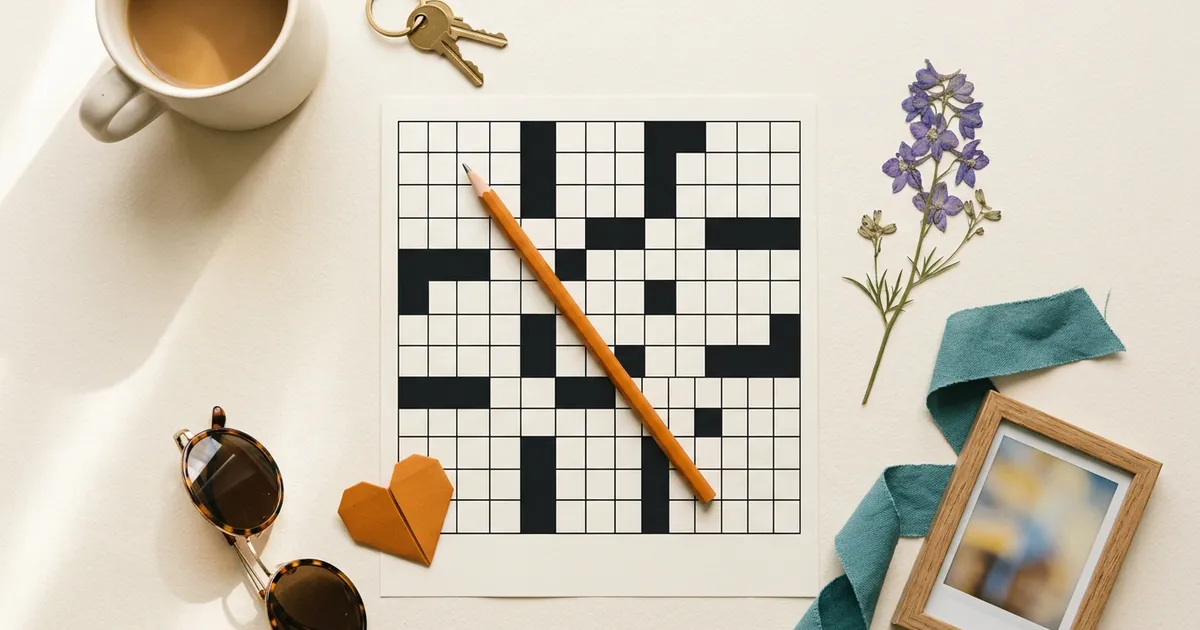
A how well do you know me quiz is a set of questions whose answers are facts about you: your first concert, the food you refuse to eat, the city you would move to tomorrow. Friends guess, you reveal, and the score tells you who has actually been listening. This post gives you 28 questions to use, grouped by friends, partner, and family, and then shows you a version of the game that people finish instead of abandoning halfway down a list.
The problem with the standard format is not the questions. It is the delivery. A list of 150 questions is great to read and terrible to play: someone has to read them aloud, someone has to keep score, and the whole thing depends on everyone sitting in the same room with the patience to get to question 40. In a group chat it dies by question six.
So take the list first. Then, if you want people to actually play, turn it into something with a finish line.
28 how well do you know me questions
Use these as they are, or as prompts for your own. The rule that makes a question work: the answer should be one specific, checkable thing. "What is my comfort movie" scores cleanly. "What do I value in life" starts a lovely conversation and cannot be marked right or wrong.
For friends
- What is my go-to coffee or tea order?
- What is the one food I will not eat?
- What was my first job?
- Which city was I born in?
- What is my most-replayed song or album?
- What is my useless talent?
- Which app do I open first in the morning?
- What was the first concert I went to?
- What is my go-to karaoke song?
- Which chore do I secretly enjoy?
For a partner
- Where did we go on our first real date?
- What is my order at our regular restaurant?
- Which of my habits do I know annoys you?
- What is the one gift I still talk about?
- What am I most afraid of?
- What time do I actually fall asleep?
- Which of my friends would I call first with bad news?
- What was I wearing when we met?
- What is my dream holiday, budget aside?
- Which household task will I always volunteer for to avoid a different one?
For family
- What was my nickname as a kid?
- Which subject did I fail or nearly fail at school?
- What was the first pet I ever had, and its name?
- Which relative do I take after most?
- What did I want to be when I grew up, at age seven?
- What is the family recipe I actually know how to cook?
- Which holiday tradition do I quietly dread?
- What is the story about me that gets retold every single year?
Eight to twelve of these is the right size for one round. Fewer and a lucky guess swings the whole score. More and people start skimming, which is the moment the game stops being about you.
Three ways to run it
Once you have your questions, you have to pick a format. Each one trades something.
| Read a question list aloud | Generic quiz app | A Know Me Test crossword | |
|---|---|---|---|
| Setup effort | None | Pick from preset questions | Type your facts, clues get written for you |
| Works in a group chat | Poorly | Yes | Yes |
| Friend needs an account or install | No | Usually yes | No |
| Questions are actually about you | Yes | Often generic | Yes, they are your own sentences |
| Keeps score | Someone has to | Yes | Automatic, per answer |
| Everyone's results in one place | No | Sometimes | Yes, one shared scoreboard |
| Takes longer than 60 seconds to play | Depends | Rarely | Yes, it is a puzzle |
| Free | Yes | Often paywalled | Yes |
The last two rows are the interesting ones. A multiple-choice quiz is over in under a minute, and a one-minute answer does not feel earned. A crossword makes someone sit with the question. When your friend stares at a seven-letter gap and eventually types BISCUIT because they remembered your dog, that is a different feeling than tapping option C out of four.
Turning your facts into a crossword
Grid Genius has a mode built exactly for this, called the Know Me Test. It lives at play.gridgenius.app/create/personal?mode=know_me and it is free.
You do not write clues. You write facts, in the first person, the way you would say them out loud:
- My dog is named Biscuit
- I cannot stand cilantro
- My first job was at a bakery
- I climbed Kilimanjaro in 2019
- My comfort movie is Inception
Three to ten of those is enough. AI reads each one, picks the answer word, writes a crossword clue in your voice, and adds a gentler backup hint for anyone who gets stuck. Then it packs everything into a grid. Nothing is locked: every clue, answer, and hint opens in the word-list editor before you save, so if the AI phrases something in a way that does not sound like you, change it. This is the same fact-to-clue engine behind our guide to the personalized crossword gift, pointed at yourself instead of at someone else.
When you save, you get a link. Send it.
Make Your Know Me TestWhat your friend sees
They tap the link and the puzzle opens in their browser. No install, no account, no signup wall in front of the grid. A small label at the top says "Know Me Test" and how many questions there are, so they know from the first second that they are being scored.
Every across and down answer is one question. Fill it in yourself and you knew it. Reveal it and you did not. Asking for an AI hint that rewords the clue is deliberately not a miss, because a reword rephrases the clue without ever showing a letter, so the answer still came out of their head.
When the grid is finished, they get a verdict instead of a plain congratulations. Score above ninety percent and it says Certified soulmate. Above seventy, Inner circle. Above forty, Getting there. Below that, the friendliest tier in the app: Time for a coffee date. Nothing scolds anyone, which matters, because the point is to start a conversation and not to end one.
Then they can add their name, and their result joins the scoreboard for that test: everyone who has solved it, ranked by score, ties broken by who got there first. Results are recorded the moment the grid is completed rather than when the sheet is dismissed, so a friend who closes the tab in the middle of celebrating still shows up on your board.
If you were signed in when you made the test, each finish also sends you a notification: the solver's name and their score out of the total. And when you reshare the link later, the preview card that unfurls in the chat is the live scoreboard rather than a generic puzzle image, which is what turns one test into a running competition between your friends.
The couples version
The couples angle is the one most people are actually searching for, and it is where the format earns its keep. The classic couples quiz is asymmetric in a way nobody enjoys: one person interrogates, the other performs. A crossword flips it. You each build one about yourself, you swap links, and you both solve at the same time on your own phones.
Make yours specific to your relationship rather than to your biography. Questions 11 through 20 above are a starting point, but the best ones are usually smaller than that: the phrase you always say, the exact coffee order, the show you refuse to watch without them. If you are building this for an anniversary or a quiet Friday, our guide to crossword puzzles for date night has more on shaping a puzzle around shared memories.
Two habits worth stealing:
Keep it to eight facts each. A short, dense test where every clue lands beats a long one padded with things anyone could guess.
Swap and solve at the same time. The scores matter less than the running commentary while you solve. Half of these answers get argued about, and the argument is the game.
If it turns competitive, it can keep going. Grid Genius also supports crossword duels, where you both race the same grid and a scorecard settles it, and it can produce a spoiler-free share card of your solve that shows your time and how much help you needed without revealing a single answer.
Writing facts that make good clues
A few patterns hold up better than others.
Concrete nouns beat abstractions. "My dog is named Biscuit" gives a clean answer word. "I am a dog person" does not.
One fact, one answer. If a sentence contains two guessable things, split it into two facts and get two questions out of it.
Mix difficulty on purpose. Two or three that everyone will get, five or six that only close friends will, and one that almost nobody knows. A test where every clue is impossible is not revealing, it is just a wall. The near-impossible one is the clue people will screenshot.
Avoid anything that stings. Family and partner tests read very differently on a bad day than on a good one. Aim for detail that is fun to be caught knowing, not detail that is a test of loyalty.
Say it the way you would say it aloud. The AI writes the clue in the voice of your sentence. Plain and casual in, plain and casual out.
Why a puzzle beats a list
The reason the 150-question listicles rank so well and get played so rarely is that reading a question is free and answering twenty of them out loud is not. There is no artifact at the end, no score, nothing to send back.
A crossword closes all three gaps. It has an ending, so people finish. It scores itself, so nobody has to keep count. It produces a result worth sending, so the game spreads sideways: your friend finishes, sees the scoreboard, and makes their own test to send back to you. That loop is the whole point, and it is the part a list of questions can never do.
Start with the questions above. Pick your eight. Then decide whether you want to read them out or make people work for it.
Frequently asked questions
It is a quiz where the answers are facts about you. You write the questions, your friends or partner guess, and their score says how closely they have been paying attention. It is usually played from a list of questions read out loud, though you can also turn your facts into a puzzle people solve on their own time.
Eight to twelve is the sweet spot. Fewer than eight and one lucky guess swings the score; more than about fifteen and people start skimming. If you build a Know Me Test crossword in Grid Genius, you write three to ten facts and the puzzle ends up with roughly eight to twelve scored answers.
The Know Me Test is free on the web at play.gridgenius.app, and your friends do not need to install anything or create an account. They open your link in any phone or desktop browser and start solving.
Every across and down answer counts as one question. An answer you filled in yourself counts as knowing it, and an answer you revealed counts as a miss. Asking for an AI hint that rewords the clue does not count against you, because a reword never shows a letter.
Yes. Every finished attempt lands on that test's scoreboard, ordered by score, with the solver's name if they typed one. If you were signed in when you made the test, you also get a notification each time someone finishes, showing their name and score.
Specific and checkable beats deep and philosophical. 'My first concert was Radiohead' has one right answer that a close friend either knows or does not. 'What matters most to me' is a lovely conversation but an unscoreable question.
A real crossword on any topic.
AI-generated puzzles with smart hints that help you think, not just give away answers. Free to play, no sign-up required.