Best Word Games in 2026: Beyond Wordle
The top word games to play in 2026, from Wordle, Connections, and Spelling Bee to Grid Genius, with AI crosswords on any topic and AI hints that help you think. Find the perfect word game for your time, skill level, and mood.
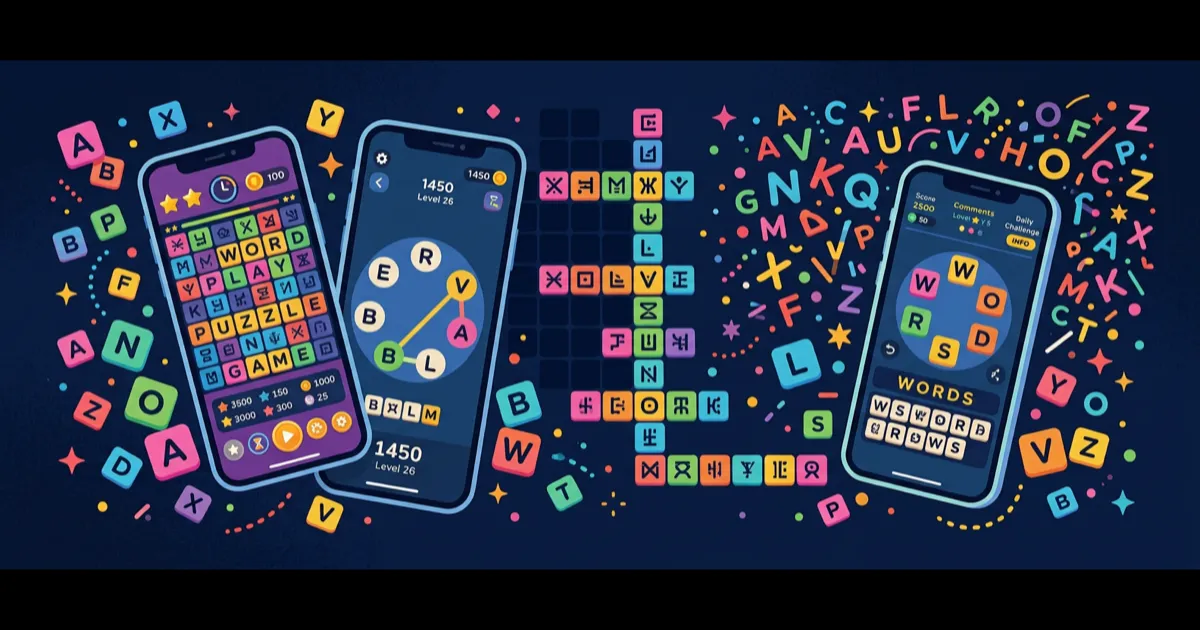
Wordle put daily word games on the map. But in 2026 the genre is far bigger than a single five-letter puzzle. From AI crosswords on any topic to group-solving experiments and physical tile races, here are the best word games worth your time, and how to pick the right one for how you actually play.
There is no single best word game. Wordle owns the two-minute daily, NYT Connections is unbeatable with friends, and Grid Genius is the most versatile pick, with AI-generated crosswords on any topic, AI hints that help you think, and the strongest brain-health research behind it. Here is how the top games compare.
At a Glance
Here are the top picks by what you care about most.
Not Sure Which Game Is for You?
Answer four quick questions and we'll point you to the game that fits how you actually play.
What pulls you in?
Quick Comparison
Every game here is worth playing, but they reward very different moods. Tap a filter to narrow the field to what you want right now.
| Game | Format | Time | Daily | Any topic | Groups | Brain | Free |
|---|---|---|---|---|---|---|---|
Grid Genius | Intersecting grid | 3–30 min | High | ||||
Wordle | 5-letter guess | 2–5 min | Moderate | ||||
NYT Connections | Grouping | 3–10 min | Moderate | ||||
NYT Spelling Bee | Spelling | 10–30 min | Moderate | ||||
NYT Strands | Word search | 5–15 min | Moderate | ||||
Wordscapes | Word building | 5–15 min | Low–Moderate | ||||
Bananagrams | Tile race | 10–20 min | Moderate |
The 7 Games, Reviewed
01Crossword Puzzles (Grid Genius)
Editor's pickThe classic intersecting-word grid is still the most rewarding word game there is, and Grid Genius modernizes it: instead of a fixed library, it uses AI to generate a unique crossword on any topic you choose, with hints that nudge you toward the answer instead of revealing it.
Try the hint mechanic right here. This is a live demo:
- Any topic you choose: Enter "Quantum Physics" or "Taylor Swift" and get a unique puzzle built around it
- AI hints that teach: When you are stuck, the AI rewords the clue from a new angle instead of handing you the answer. No other word game does this.
- Three sizes, three difficulties: Nine combinations from a five-minute Mini to a sit-down Large
- Free daily challenge: A fresh puzzle every day with a global leaderboard and streaks
- Built-in maker: Create crosswords from your own words and share any puzzle for free
- Cross-platform: Play on iPhone, Android, or the web and pick up where you left off
- ·Free: daily challenge, community puzzles, the maker, and 3 AI puzzles to start plus 1 more each day
- ·Pro ($7.99/month or $49.99/year): unlimited AI puzzles and hints, ad-free
02Wordle
Guess a five-letter word in six tries. Green means right letter, right place. Yellow means right letter, wrong place. Gray means the letter is not in the word. That is the whole game, and it is close to perfect.
- Designed for two minutes: One word, six guesses, no setup
- The shareable grid: Those colored squares turned a solo puzzle into a daily social ritual
- Same word worldwide: Everyone solves the same puzzle, so it travels well in group chats
- Simple rules, real depth: Opening-word strategy runs surprisingly deep
- ·Free on the NYT site and app
- –One puzzle a day, then you are done
- –No topics, sizes, or difficulty settings
- –Archive access requires a subscription
03NYT Connections
Group sixteen words into four categories of four. The categories range from obvious to deviously tricky, and the overlap between them is the whole trap.
- Lateral thinking: You are sorting by hidden connections, not spelling
- Four tiers of trick: Yellow is easy, purple is fiendish, and the words that could fit two groups are the catch
- Better with people: Everyone brings different knowledge, so it shines in a group
- Shareable results: A daily emoji grid, much like Wordle
- ·Free on the NYT site and app
- –One puzzle a day
- –No custom categories or topics
- –Difficulty swings a lot from day to day
04NYT Spelling Bee
Make as many words as you can from seven letters, always using the required center letter. Find the pangram that uses all seven for a bonus.
- Open-ended: No single right answer, just more words to find
- A real vocabulary dive: You will rediscover words you forgot you knew
- Satisfying ranks: Climb from Beginner to Genius, and chase Queen Bee
- A daily community: People compare missing words and the day's pangram
- ·A few plays are free
- ·Full game needs NYT Games ($4.25/month)
- –Behind a subscription after a taste
- –Can eat far more time than other dailies
- –No topics or difficulty settings
05NYT Strands
Find themed words hidden in a letter grid, running in any direction. A "spangram" stretches across the board and reveals the theme that ties everything together.
- The theme is the puzzle: Half the fun is working out what links the words
- A fresh format: Word search crossed with theme discovery
- Daily, with hints: Stuck solvers can earn a nudge
- ·Free on the NYT site and app
- –One puzzle a day
- –A lighter brain workout than a crossword
- –No topics you choose
06Wordscapes
Form words from a set of scrambled letters to fill a crossword-style grid. There are no clues, you simply find the words the available letters can spell.
- Low barrier: A simple swipe-to-spell mechanic anyone can pick up
- Calm by design: Soothing nature backdrops and gentle pacing
- Endless levels: Thousands of stages to work through at your own speed
- A daily puzzle too: For a quick, fixed challenge
- ·Free with ads
- ·In-app purchase removes ads
- –Not really crosswords, there are no clues
- –Ad-heavy on the free tier
- –Gets repetitive at higher levels
07Bananagrams
A fast-paced tile game where everyone races to build their own interconnected word grid. Think Scrabble without the board, the scoring, or the waiting for your turn.
- Physical and fast: Real tiles, a real table, no screens
- No scoring: First to use every tile wins, simple as that
- Great for families: Easy to teach, quick to play, hard to put down
- Travels anywhere: The whole set lives in a little banana-shaped pouch
- ·About $15 for the physical set
- –You need other people in the room
- –No daily puzzle or progression to come back to
- –Not a digital or solo option
The Ideal Daily Word Game Routine
You don't have to choose just one. Many word game fans string a few together each day.
The 10-minute routine Wordle (2 min) → a Grid Genius Mini crossword (5 min) → Connections (3 min).
The 20-minute routine A Grid Genius Standard crossword (15 min) → Wordle (2 min) → Connections (3 min).
The brain-health routine A Grid Genius Daily Challenge (10 to 15 min), the format with the strongest cognitive research behind it.
The thread running through every routine is the crossword, because it is the one format that scales from a five-minute warmup to a proper workout, on any topic you like.
How to Choose Your Word Game
Pick based on what matters most to you right now.
Frequently Asked Questions
The standouts in 2026 are crossword puzzles (Grid Genius for AI-generated puzzles on any topic with AI hints, NYT for classic hand-crafted ones), Wordle (the two-minute daily five-letter guess), NYT Connections (group 16 words into 4 categories), NYT Spelling Bee (make words from 7 letters), NYT Strands (a themed word search), and Wordscapes (casual word building). Bananagrams is the best off-screen pick for game nights.
Wordle, NYT Connections, and NYT Strands are free. Grid Genius is free to play daily, with a free crossword maker, and every account includes 3 free AI generations on any topic plus 1 more each day (Pro is unlimited from $7.99/month). NYT Spelling Bee is free for a few plays, then needs an NYT Games subscription. Wordscapes is free with ads.
Crossword puzzles have the strongest research backing for cognitive benefits. A Duke/Columbia study found crosswords outperformed brain-training games at improving memory. They exercise vocabulary retrieval, pattern recognition, and language processing at once, which is why Grid Genius leads our list for brain exercise.
Wordle takes 2 to 5 minutes, a Grid Genius Mini crossword takes about 5 minutes, and Connections runs 3 to 10 minutes. Spelling Bee has no time limit but most sessions run 10 to 15 minutes, and a standard crossword is 10 to 30 minutes.
NYT Connections is the best digital group game, because everyone brings different knowledge to spotting the four hidden categories. For an off-screen night, Bananagrams is the best social pick, a fast tile race to build your own word grid with no turns to wait through.
Yes. Grid Genius is the only major word game that generates a puzzle on any topic you name, from "Marvel Movies" to "Molecular Biology," across three grid sizes and three difficulty levels. Most other word games use a fixed daily puzzle with no topic choice.
If you like Wordle's daily, shareable format, try NYT Connections (grouping), NYT Strands (themed word search), and NYT Spelling Bee (vocabulary). For more depth and the ability to choose your own topic, a daily crossword from Grid Genius scratches the same itch with a bigger puzzle.
A real crossword on any topic.
AI-generated puzzles with smart hints that help you think, not just give away answers. Free to play, no sign-up required.